My interdisciplinary scholarship is informed by the question: how do communities make sense of contested spaces – including civic, ecological, and technical – through rhetoric? This question runs through my research, from the parks and green spaces that anchor urban civic life, to coastlines and ecosystems undergoing climate-driven change, to classrooms being being reshaped by new technologies. My work spans three interconnected areas: (1) rhetoric of place, space, and civic life; (2) environmental and science communication; and (3) communication pedagogy in an era of emerging technology. As an early career teacher-scholar, I am looking for opportunities to continue to pursue research into the ways in which rhetoric is entangled in contested spaces.
Critical Pedagogy and Praxis
My commitment to engaged scholarship informs my critical pedagogy and practice. My first publication, “The transformative power of communication,” made as much a statement of my philosophy of teaching communication studies as it was an argument for the widespread adoption of communication practices and pedagogy across the curriculum. I highlight the importance of incorporating opportunities for students to practice communicating through debate, deliberation, discussion, and delivery in diverse educational environments. I argue engagement with these communicative processes teaches students valuable skills in critical thinking, can contribute to a more inclusive class culture, and aids in developing tools for civic engagement. My interest in developing inclusive learning communities was also the animating reason for my contribution of the entry on “Access” to Keywords for Today. This central premise—that communication has the power transform—is at the heart of my work as a teacher-scholar.
More recently, I have been researching the uses of new technology to support student speaking competencies. I am part of a research group at Randolph-Macon College studying the utility and limitations of virtual reality (VR) as a tool for speech practice in the Public Speaking course. In collaboration with the other Public Speaking instructors and the technology and academic design specialists in the college MakerSpace, we surveyed student experiences and perceptions of the efficacy of using VR as a tool to enhance speech preparedness and reduce speech apprehension. Survey results indicate that most students found the scaffolded VR practice sessions beneficial in enhancing speech preparedness, while a smaller set of students found VR practice session helped reduce speaking apprehension. We suggest VR is a complementary teaching tool that can support efforts to provide students with a diverse set of speech practice methods necessary to support diverse classrooms achieve their learning objectives. Our research was presented on the top paper panel of the 2024 National Communication Association conference in the Basic Course Division and published in Communication Education. A second publication from this project explores the role of virtual reality in supporting oral communication pedagogy.
Environmental Communication & Rhetoric and Place, Space, and Civic Life
When I first moved to Pittsburgh to begin my doctoral program, I found myself repeatedly crossing Pittsburgh’s uneven sidewalks and signature row houses to crushed gravel and tree canopies and back again as I visited nearby Shenley Park. My frequent visits to Shenley Park ignited my profound interest in the spatial and temporal rhetoric of urban environments and engaged, participatory, and in situ methods of rhetorical criticism. My engagement with natureculture experiences in urban regional parks through embodied and experiential rhetoric was the basis for my essay published in Environmental Communication. In that essay, “Blurred Borderlands,” I explore how sustainable development projects attempt to communicate positive affective relationships between publics and the environment by creating experiential landscapes that blur the boundaries of what is natural in urban environments.
My time spent visiting Pittsburgh’s parks also brought up questions about how the relationship between parks and industrialization influenced public life in Pittsburgh, which became the topic of my dissertation research, “Civic Spaces: Rhetoric of Pittsburgh’s Parks System.” Drawing on archival research, textual analysis, and participatory critical rhetorical field work, I examine how parks are rhetorically figured in, with, and through civic planning initiatives to shape public ideas around topics like citizenship, progress and preservation, public space, and urban identity from the late nineteenth through early twenty-first centuries. Out of that research, I published “Planning for Change,” in Urban Communication Reader IV, where I delve further into urban planning as a contemporary tool for institutional change through a focus on examining the technical communication of formal master planning documents.
In 2019, I pursued collaborative opportunities to learn about engaged research methods when I was as a selected participant in the Environmental Justice group of the inaugural RSA Project in Power, Place, and Publics. Our aim was to pursue more engaging opportunities to learn about research methods with peers from diverse institutions. Over the course of several days, our group explored how environmental justice was reflected on the ground and in the proposed Campus Master Plan for the University of Nevada, Reno, resulting in a presentation to project participants and key community stakeholders. Our collaborative publication, “‘No(t) Camping,’” points to the value of engaged and intersectional approaches to research and collaboration.
Rhetoric and Ethics in Science, Technology, and the Environment
My interest in participatory field methods and questions of rhetorical ecology led to further questions surrounding science, technology, and the environment. I secured a position as a Postdoctoral Research Associate with the Maine-eDNA Project, an NSF track-1 grant, supporting transdisciplinary collaboration aimed at research, education, and outreach to better understand and sustain coastal ecosystems through new scales of inference and new scales of collaboration using environmental DNA. In addition to leading small group conversations in our Science of Team Science team, I helped organize and host a Virtual Ethics of eDNA Workshop to facilitate deeper project conversations surrounding important ethical topics like data management and sharing, sampling in indigenous waters, and the history of institutional research ethics. Our publication in Frontiers in Communication, “How Does Strategic Communication Shape Transdisciplinary Collaboration?,” pointed to the importance of both studying and shaping communicative practices in transdisciplinary collaborations through a focus on definitions, audience, expertise, and ethical praxis.
At present, I am collaborating on a manuscript examining how ‘tipping point’ functions rhetorically as a chronotope in climate change discourse. While tipping points convey urgency and irreversibility of climate change, they often obscure the complex, uneven, and ongoing nature of ecological occurrences. We argue that tipping point discourse often relies on scalar logic that privileges singular events over relational and processual understandings and suggest that climate discourse requires a new scale-making project for understanding climate tipping points that is rooted in multiplicity to better account for the varied ways climate change is experienced and communicated.
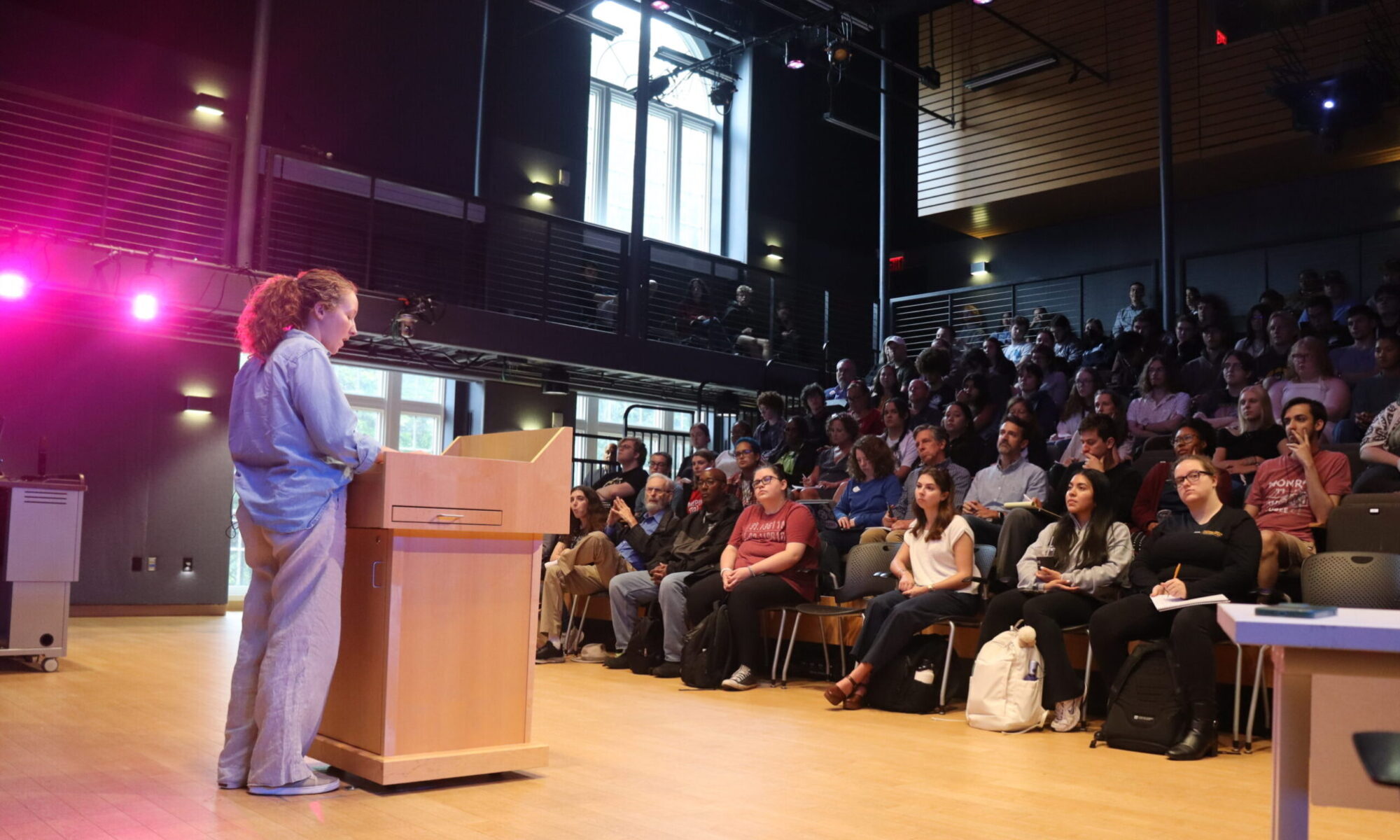
I also recently participated in the inaugural public debate for UMW’s Center for AI and the Liberal Arts on AI and the Environment, where I affirmed the resolution that “AI’s impact on the environment over the next decade will be negative.” Beyond the question of AI’s environmental impact, I take a rhetorical approach to study how AI and the environment are made meaningful in public discourse, which I have begun to build out in my broader research agenda.